The Cycle of Modern Game Companies November 4, 2011
Posted by Maniac in Editorials.add a comment
When the news hit that Sony had bought out Sucker Punch, I started thinking more and more about just what the companies who make video games have to go through during their life cycles. After looking at it for over ten years, I’ve been noticing a pattern over the past few development cycles starting to emerge. I don’t like it one bit, and I think the rest of the industry shouldn’t like it either.
During the early days of the gaming industry it was exactly as you probably imagine it was. A bunch of geniuses would get together in a dorm room or an apartment and use their programming and art skills to make a game for the early computers. Back then it didn’t take much to publish a game. You could make floppies with the game, seal them up in a ziplock bag, put a label on it, and sell them in quantities to computer stores, who would put them on the shelves alongside the games made by major publishers. There wasn’t a lot of overhead back in those days. The teams were very small, averaging around five people, who would be building these games in their spare time on computers they already had (or stole from work). They wouldn’t bother with stuff like offices or marketing, there was just no need. The market was so small anyway that everyone was treated with legitimacy and if you could make a game that was good, you’d do well for yourself.
id Software was one of the poster childs of this era. They had started as just a few employees of a larger company that were not being allowed to make they projects they wanted to make, so every weekend they’d steal their computers from work, and build video games in a lake house in Shreveport. After they completed the first Commander Keen trilogy for Apogee (later 3D Realms), they were taking in checks for $65,000 a month!
As technology improved, more and more people got into the business interested in getting in on this quickly booming business. Larger teams of developers would be needed to have projects completed quickly. With technology improving rapidly, new people were needed to bring different skills to keep up with the advances in technology. With all these people, creating a real business would be a necessity because people would need to be paid a salary and have a place to work. This didn’t bother the early startups. They had done really well the first time around, and had the money to expand their businesses, nor were the publishers bothered, because they were making most of the money from games sold anyway.
The problem is once you fail things are going to become very difficult for you. Heck, even if you’ve made a great game, you can’t pay your employees with review scores, it has to make money for your company.
Once the company has been exploited as far as it can be, if the publisher isn’t interested in any other projects they have to offer or have no other projects they want them to make, the company is either shut down or absorbed completely by the publisher. This happens FAR too often!
Microsoft is NOTORIOUS for doing this. After the completion of Shadowrun, Microsoft shut down FASA Studios, which had produced fantastic games under Microsoft’s publishing arm for years including the Mechwarrior series and the fan favorite series Crimson Skies. I heard musings that they would work on a Crimson Skies game after completion of Shadowrun, but with the company shut down it never came to fruition. Did anyone else notice the way Jordan Wiesman talked in the Ode To Bungie documentary when he told the story about how he was asked by Microsoft to tell Bungie that being owned by Microsoft wasn’t that bad just so they could strike a deal. I’m sure during that interview Weissman realized the irony of that statement now that Microsoft had shut his company down four years earlier.
There’s also the story of Digital Anvil, a company created by Chris and Erin Roberts, who were responsible for the Wing Commander and Privateer series while working at Origin. When they decided to strike out on their own to make a new universe of similar games, Microsoft stepped in initially just as a publisher for four games the company had under development. After the release of their first game, Starlancer, Microsoft started putting more money into the company, eventually getting ownership of it, and the Roberts brothers left. Two of the games the company was working on got canceled outright, although one of the games, Conquest: Frontier Wars, was so far along in development another publisher picked it up to finish and release it. Digital Anvil existed just long enough to release the long in development and much hyped Freelancer game, which even though it sold extremely well and got very high reviews, could not save itself from being fully absorbed by Microsoft.
Do I even need to talk about Ensemble Studios? I think everyone knows what happened to them after Halo Wars got released, and these were the guys who made the Age of Empires series, considered by many the best Western RTS guys in the world!
Is this what we’ve become? An industry where a promising startup forms under the banner of a visionary industry veteran. A lot gets invested in it by a publisher. The game ships and either doesn’t pay it’s bills or doesn’t make enough to fund another game, and the company dies. It’s happened so many times. Flagship Studios is a huge poster child for this. Here was a company formed by Blizzard veterans who promised to redefine the traditional PC RPG game with a whole new business model of tiered multiplayer. It would be a single player game with an MMORPG component as well, use the most recent DirectX graphics engine to take full advantage of new PC hardware. Sales would come in from retail sales and the optional MMO subscriptions. The problem was the publishers were the ones calling the shots with the game and not the developers, and they forced the game out before it was finished. Initial reviews of the game were lukewarm, and while the developers did improve the game tremendously through patches, the initial reviews weren’t going to be changed, and the costs of maintaining the company and the game’s MMO portion was higher than they were taking in sales and subscriptions, and the plug was pulled.
Even for the independent companies, no matter how successful they are, or how many good titles they’ve developed, to publishers with money, they’re only as good as their next project. Troika Games was responsible for releasing some very fun and yet very undercooked games for the PC, which were well designed but released extremely buggy. I will admit to everyone who will listen to me that I loved Vampire: The Masquerade Bloodlines with all my heart, and playing it every summer has been a tradition. The game’s atmosphere was second to none. They took a realistic environment like Downtown Los Angeles, California, added in the premise that everything that we assume bumps in the night was in fact real, and created a very atmospheric game with mature themes that worked perfectly for the environment and subject matter. Only it was released before it was ready and had tons of gameplay bugs and a really nasty memory leak. When the company was ready to pitch its fourth project, no one was interested in it, and the studio heads shut the company down, cutting off any chance for them to continue development on Bloodlines to fix the issues with it.
Some companies tried to buck this trend and do something creative to prevent something like this from happening to them. It was met with mixed success. Back in 2006, there was a huge resurgence of companies interested in episodic gaming. The three companies which were poster childs for this, Valve, Ritual Entertainment, and Telltale Games, planned to release games episodically at a lower price for each individual game. The intention was to use the same tools to continue game development through an entire series, with each episode funding the next one. The problem with this business model was that the money made from each individual episode was enough to cover costs of development of the episode, but not enough to cover development of the next episode. Valve survived this because they were Valve, but Ritual not able to weather this storm, and to survive they were bought out by Mumbo-Jumbo, which absorbed them. This stopped support for the SiN Episodes, even though many updates and patches to the game was promised and even ready for deployment. But you could tell Valve’s perspective on Episodic Gaming had been changed. When Half-Life 2 Episode 2 released, it was bundled with four other games, two of which were already released, to get them a full retail price point. How dead is Episodic Gaming? The fact there has not been a word spoken about Half-Life 2 Episode 3 in over three years speaks volumes about that.
However, Telltale Games thrived under these circumstances, since unlike the other two companies, they charged a price point for not just individual episodes, but offered a deal to sell all episodes in advance by paying a flat fee, and they would go out to the customer when finished. However, in the past year I have noticed Telltale has been quick to start taking preorders for the full downloadable games months before a first episode is even released. Of course, they still will give you the game when it releases and the option to pay just for shipping when all the episodes are released to DVD-ROM, but you could be paying upwards of $40US up front for that now.
Bungie is the only exception I can think of to this rule. After making millions upon millions of dollars in profits for Microsoft with the Halo series of games (in exchange for it’s 60 million purchase price), Microsoft let Bungie have their freedom back in exchange for two more Halo titles (which were Halo 3 ODST and Halo Reach). With their freedom, there was no way Bungie would share the fate of companies like FASA or Ensemble, but Microsoft would keep the rights to the Halo franchise.
How can a whole industry survive, let alone thrive, if all the new talent isn’t being given the chance to throw their hat into the ring and make games? It just doesn’t make business sense for a company to form, release a game, then be shut down after the game completes, forcing its employees to form a new company and start the cycle all over again.
We can’t be an industry that is built on the backs of the same companies that started this whole thing in the first place, because even some of them are falling on hard times with poor products coming from very long development cycles. Duke Nukem Forever is what killed 3D Realms. They spent more years than they probably should have developing the same game over and over again thinking each time that the new product they were creating was better than the old one, when in fact people would have been fine with if they simply released the game they showed back in 2001! The cost of development over the extreme number of years bled the once highly profitable company’s profits and overnight it shut down. The game would be saved, but the lesson remained nevertheless.
However, it seems that with the release of smartphones like the iPhone or Android, the industry may have hit a reset button. Almost overnight a new breed of game developers saw these new devices and the new marketplace they ushered in and decided that was where they wanted to stake their claim. Once again overheads are low and because of that profits could be high as the sky. With the device’s low cost, great features, and decent hardware, an enormous install base has come from it. Games selling at .99 cents a download have made some developers overnight millionaires and in the always connected internet age, word of mouth travels fast for what is good and what isn’t. They’re not forced to pony up large amounts of cash up front or be heavily in debt from the outset like startups are nowadays. Failure, even on a monetary basis, might not be fatal to the company. Without the worry of having to sell, creativity has the chance to thrive in this new environment.
We could be seeing the start of a whole new generation of games coming from a completely different mindset that is not based around the PC or Console at all. I mean, everybody’s gotta have a phone these days don’t they?
Back to the Future The Game Deluxe Edition Unboxing November 4, 2011
Posted by Maniac in Site Videos.add a comment
I have a very special, um…special edition to unbox for the site today. This is the Back to the Future: The Game Deluxe Edition. You can only buy this off Telltale’s Official Website, and if you have already purchased the downloadable version of the game, you can buy this at a discount.
This has a $20US premium over the game’s Collector’s Edition, which includes all five of the downloadable Back to the Future game episodes, as well as exclusive DVD special features on the disc. The Deluxe Edition includes the Collector’s Edition disc (with an alternate cover) as well as some extra goodies.
Is it worth it? I crack it open and see.
Uncharted 3: Drake’s Deception Collector’s Edition Unboxing November 2, 2011
Posted by Maniac in Site Videos.add a comment
Uncharted first released in 2007, one year after the PS3 launched, but it quickly became the most popular exclusive of that holiday season. When Uncharted 2 released in 2009, it recieved more than just game of the year awards for the PS3, it recieved game of the year awards among ALL platforms.
Now, Uncharted 3 is out, and I picked up the first ever Collector’s Edition for the series that was released to retail. Is it worth picking up? Watch the video for my review.
The Darkness II NYCC Preview November 1, 2011
Posted by Maniac in Previews.add a comment
While at the New York Comic Con I was privileged to demo the game The Darkness II, which I have been highly anticipating for some time. A sequel to 2007’s The Darkness for the PS3 and Xbox 360, the Darkness tells the story of Jackie Estacato, a mafia hit man who on his twenty-first birthday inherits the Darkness, supernatural powers passed on to him by his family. With these new powers he avenges the death of his girlfriend Jenny and takes control of the Estacato crime family.
Two years later, Jackie finds himself sore, beaten, and nailed to a wall, which is exactly how the game’s demo began. More than just the mafia are aware of the dark powers that lurk within Jackie, a Brotherhood which wishes to possess the powers within him once again have him held captive and begin to torture him with the intention to take the powers from him for their own nefarious purposes. The demo is then presented as a series of flashbacks from that moment, which the game developers assured me are being taken out of sequence from the final version of the game.
Jackie awakes to find himself inside the fanciest restaurant in New York City. Out of the pages of a Martin Scorsese script, the game automatically moves Jackie as the events around him progress, allowing the player to change his perspective to get a better view of whatever he’s looking at. As he passes by all the wise guys he makes it to his table in the back and sits down, two beautiful identical twins are at the table waiting for him. As they engage in uncomfortable small talk, one of the twins immediately gets assassinated, and a van can be seen through the window driving at a hundred miles per hour straight for the restaurant wall!
Jackie is hurt, but not out. His right hand man grabs him and starts to drag him to safety. With no way to protect himself during the following shootout, he hands you a gun and says to cover him while he gets you out of there. Then the game really begins, and you need to defend yourself as waves of enemies make their way into the restaurant, practically turning it into a war zone. One nice improvement over the previous game is that with one weapon Jackie can aim with sights, allowing for better accuracy with each shot. Halfway through the sequence, your assistant hands you a second weapon with the hope that you can do more damage with two, and indeed you can. No longer able to aim down the sights any more, it’s a fair trade-off, as you can now fire faster and can sustain shooting for longer without having to reload.
Jackie is dragged into the kitchen, just as a molotov cocktail is thrown into it. Combined with a gas leak they were just smelling, the entire kitchen is engulfed in flames and Jackie is severely injured. As Jackie views his burns all over his body, the voice of Mike Patton, who is reprising his role as the voice of The Darkness, is heard, urging Jackie to release him once again. With the push of a button, the Darkness is released, and Jackie is at full strength once again.
The next part of the level serves as a tutorial for all the new game mechanics. The Darkness no longer works the same way as it does in the first game, you can no longer switch powers around like you could previously, and instead you are given different capabilities with it immediately, such as the ability to slash at enemies and object. This gives you the ability to break through barriers and can act as a melee attack. You also have the ability to pick up object and hurl them at enemies, which the game developers likened to the Gravity Gun in Half-Life 2.
We flash back to the present, and Jackie continues to be tortured by The Brotherhood. He is taunted by his failure to save Jenny, and his inability to control the Darkness.
The game then switched to the New York City Subway. Previously serving as strictly a hub world in the first game, the subways were now filled with enemies gunning for Jackie and his powers. It is at this moment the player is made aware that Jackie’s weakness is light, and it is imperative that he destroy all the artificial lights in the subway tunnels or else he could fall more susceptible to gunfire. However, Jackie was not alone anymore. His friend, the Darkling, was assisting him through the subway, jumping on enemies to distract them and spouting insane statements. The game developers promise that this new game is unlike the previous as it is treating the Darkling in a whole new way. The Darkling, as previously depicted, were spawned minions which had different special options. They would die easily but could be just as easily respawned. Now, there is only one Darkling and he has a whole new personality. The game developers assured me that they wanted us to have an attachment to the little guy, and let me tell you, I was feeling attached.
The game faded to white once again and we were snapped back to the present. As he continued to be tortured, I thought for a moment that the big bad may succeed at taking the Darkness from Jackie, but you can’t keep a powerful hero down. Amassing his last bits of strength (as well as a quick button press), Jackie was able to free himself from his constraints and upon killing the lights in the room, use the Darkness to save himself. As the big baddie sulked away in failure and fear, he promises he will return, and “visit his Aunt Sarah.”
That sentence lingering in the air, the demo ended.
I couldn’t be happier about the progress with The Darkness II. After having seen it previously at E3 earlier this year, I was treated to a whole new section of the game which has impressed me even stronger than the last time I saw it. The game is inspired by a comic book property of the same name, and from the looks of it, that comic series is being done with the utmost of respect, and should expose a ton of gamers to the comic series, just as the first game had exposed me to it back in 2007.
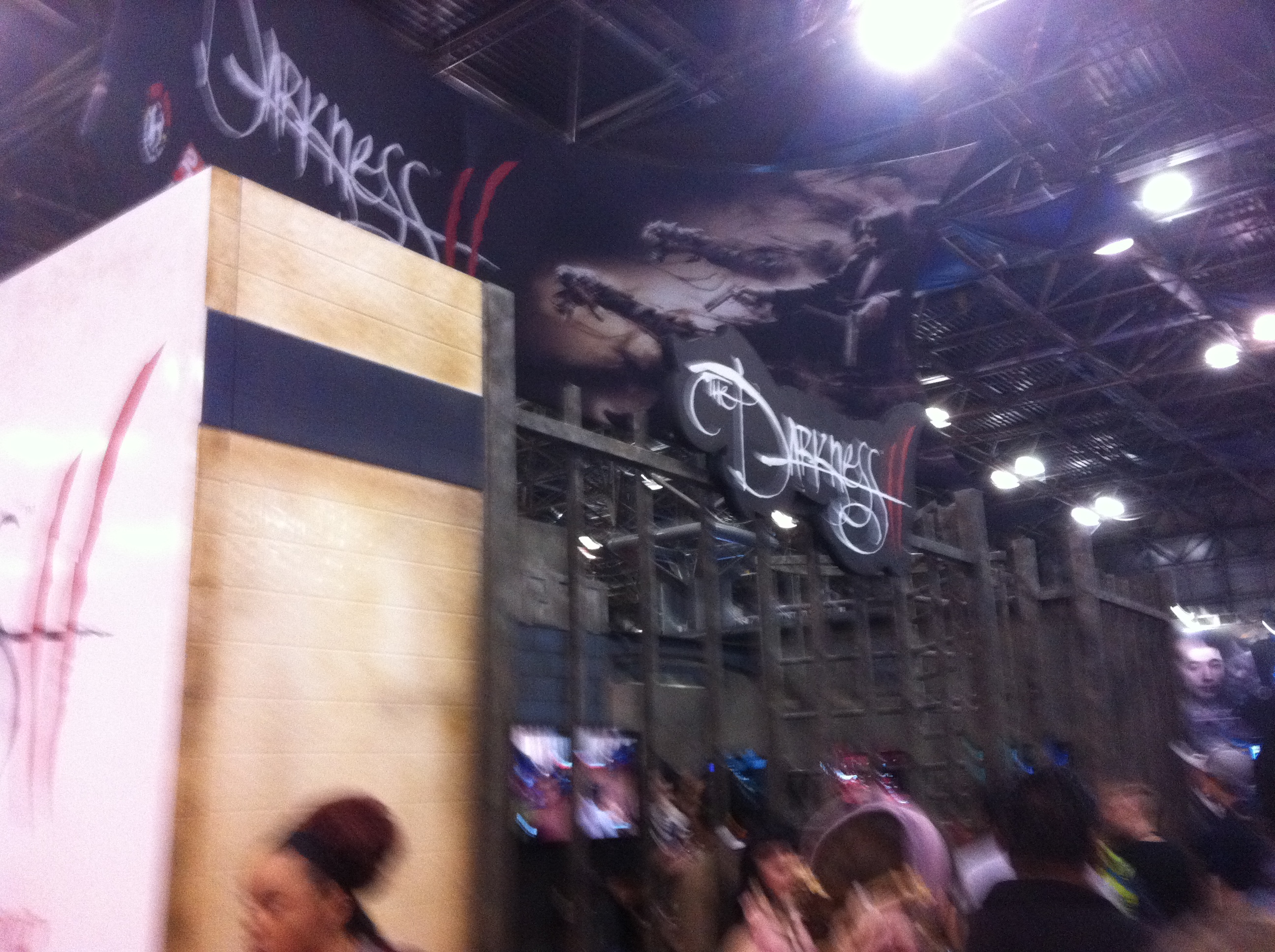
The Darkness II is coming Feb, 2012 for Xbox 360, PC and PS3.
 GameXcess.net - Gaming News, Videos and Editorials!